
How to Talk to Your Partner About Fertility Issues: A Compassionate Guide


Last Tuesday, Sarah sat on the sofa, wanting to speak, but the words felt like they might break the fragile peace she and her partner had worked so hard to maintain. She worried that bringing up her concerns would make them feel like "the problem" or add more pressure to an already strained sex life. Learning how to talk to your partner about fertility issues is often the most difficult part of the entire journey. It's a conversation that requires more than just medical facts; it needs a foundation of emotional safety.
It's completely normal to feel a loss of intimacy when your relationship starts to feel like a series of medical appointments and scheduled windows. You might also feel anxious about the invasiveness of treatments or the evolving legal landscape, such as California's Senate Bill 729 which expanded coverage in 2026. This guide will help you move past blame and rebuild your connection through proven communication strategies and shared action plans. We'll explore how to handle the financial stress of treatment and create a unified path forward that protects your bond.
Key Takeaways
- Identify your primary emotions and choose a neutral time for the discussion to avoid high-stakes moments like the bedroom or the end of a long workday.
- Learn how to talk to your partner about fertility issues using "I" statements that express your feelings while reinforcing that building a family is a shared journey.
- Protect your romantic connection by addressing feelings of guilt and finding ways to maintain intimacy that isn't tied to a medical schedule.
- Develop a collaborative action plan by sharing data and comparing initial low-intervention steps such as lifestyle changes and cycle tracking.
- Implement a 15-minute weekly check-in to manage fertility discussions efficiently and prepare as a united front for social triggers like baby showers.
Preparing for the Conversation: Understanding the Emotional Landscape
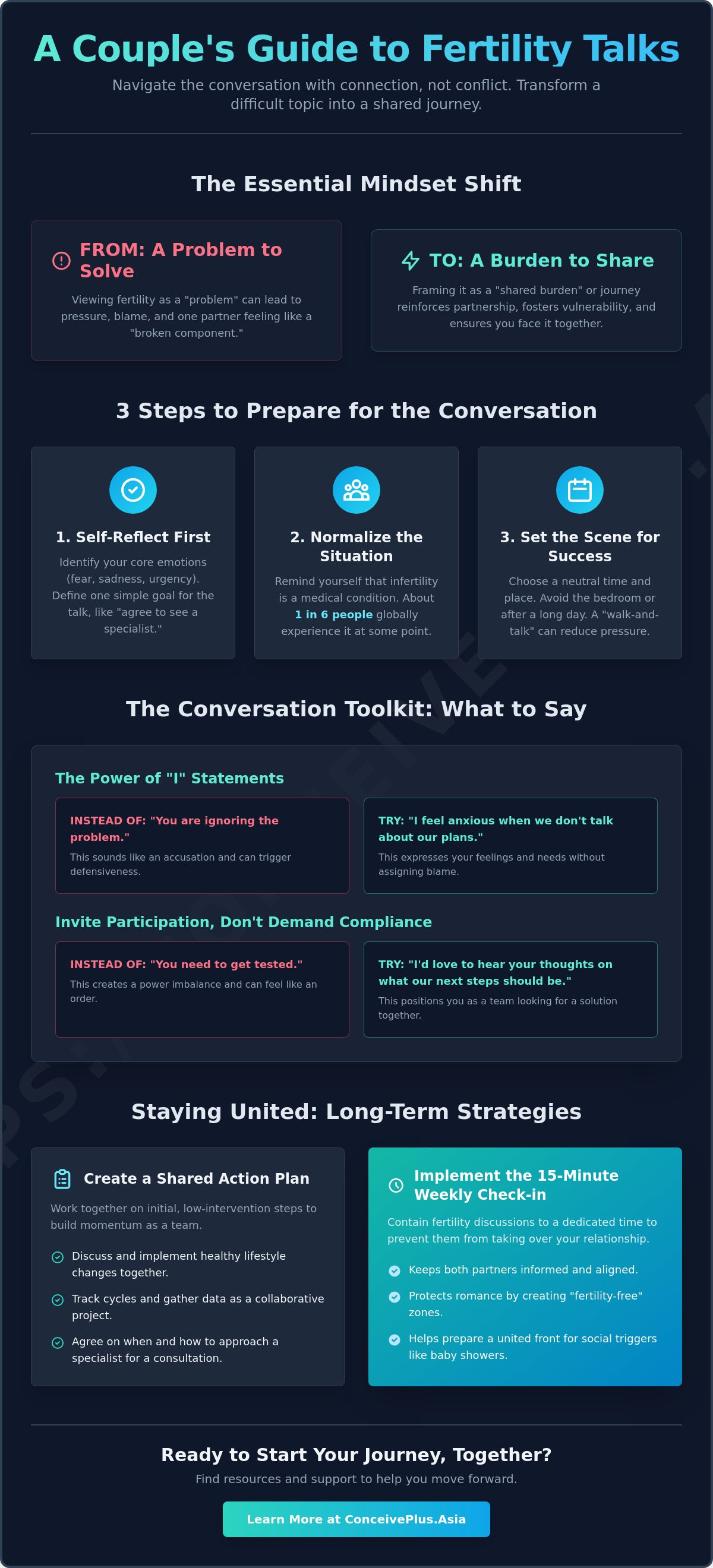
Approaching a conversation about fertility requires more than just courage; it requires internal clarity. Before you even sit down, you need to dissect your own emotional state. Are you feeling fear about the future, urgency due to age, or perhaps a deep sadness about the process so far? Understanding the emotional impact of infertility allows you to approach your partner with vulnerability rather than frustration. When you learn how to talk to your partner about fertility issues, the goal isn't to solve every medical hurdle in a single night. Instead, it's about shifting the dynamic from "solving a problem" to "sharing a burden." This subtle shift in mindset ensures that neither of you feels like a broken component in a machine.
To better understand this concept, watch this helpful video:
It's easy to walk into a room with a mental list of dates, missed cycles, and medical symptoms. However, presenting these as a "case" against your partner often triggers defensiveness. Focus on your observations of the journey as a whole. Frame the conversation as a collaborative investigation into your future together. This keeps the focus on the partnership rather than individual shortcomings.
Self-Reflection Before the Dialogue
Start by writing down a single sentence that defines your goal for the first talk. It might be as simple as, "I want us to agree to see a specialist for an initial consultation." Next, check your mental script for "blame triggers." Phrases like "You always forget the vitamins" or "We never track properly" create walls. Remind yourself that about 1 in 6 people globally experience infertility at some point. Normalizing the situation for yourself first makes it much easier to stay calm when you finally speak.
Setting the Scene for Success
Timing is everything. Avoid "high-stakes" environments like the bedroom or the dinner table immediately after a long work day. Instead, try a "walk-and-talk" approach. Walking side-by-side reduces the pressure of direct eye contact and allows for more natural pauses. Use the "10-minute rule" by asking your partner for a short, specific window of time. This prevents them from feeling ambushed and ensures both of you are well-rested. Mastering how to talk to your partner about fertility issues starts with creating this safe, neutral space for both of you to be heard.
How to Start the Fertility Conversation Without Blame
Once you have prepared your emotional landscape, the actual dialogue begins. It's vital to frame this as a shared mission rather than a solo struggle. Statistics from 2026 show that fertility challenges are widespread, yet many couples still fall into the trap of assigning blame. By learning how to talk to your partner about fertility issues through a lens of partnership, you remove the weight from one person's shoulders. Infertility is a medical condition, not a character flaw. It's a path you walk together, regardless of where the biological challenges may lie.
Instead of demanding your partner "get tested," invite them into the process. You might say, "I've been reading about our options, and I'd love to hear your thoughts on what our next steps should be." This invites participation rather than compliance. Active listening is just as important as speaking. When your partner responds, give them the floor. Don't interrupt. Let them process their feelings out loud, even if they aren't ready to offer solutions yet. Using tools like an ovulation calculator can be a low-pressure way to start gathering data as a team.
The Power of 'I' Statements
Using "I" statements shifts the focus from accusation to expression. For example, saying "I feel anxious when we don't talk about our plans" is much more effective than saying "You're ignoring the problem." The latter sounds like an ultimatum, which often leads to defensiveness. Focus on your desire for a family and your need for support. This approach validates your partner's potential fears of inadequacy. It shows them that you're looking for a partner to share the journey, not a culprit to blame for the delay.
Handling Resistance or Silence
If your partner remains quiet, don't assume they don't care. Silence is often a sign of being overwhelmed. They might be processing the fear of a diagnosis or the financial weight of treatments, which can average $23,474 per IVF cycle in the U.S. as of 2026. Offer a "grace period." You can say, "I want us to be a team in this, so if you need a few days to think about what I've said, that's okay." This reinforces the partnership without forcing an immediate answer. Recognizing how to talk to your partner about fertility issues involves knowing when to push and when to give them space to breathe.
End the conversation by summarizing what you both discussed. This ensures no one leaves the room with a misunderstanding. A simple "So, we've agreed to look at some resources together this weekend?" provides a clear, low-stress path forward. This summary acts as a bridge, turning a difficult conversation into a shared action plan.
Navigating Guilt, Resentment, and the Intimacy Gap
When a medical diagnosis highlights a specific issue with one partner, a heavy sense of guilt often follows. It’s easy for the person with the diagnosis to feel like they’re "holding back" their partner’s dreams. Conversely, the other partner might feel a quiet, unvoiced resentment. Addressing this "elephant in the room" is a critical part of how to talk to your partner about fertility issues. You must reinforce that the diagnosis belongs to the couple, not just the individual. It’s a shared medical challenge, much like any other health hurdle you’d face together. Don't let guilt fester.
The transition from spontaneous romance to "scheduled sex" is one of the most common ways intimacy erodes. When sex becomes a functional task dictated by a calendar, it loses its role as a bonding activity. Many couples find that their bedroom becomes a place of pressure rather than pleasure. To bridge this gap, create "Fertility-Free Zones" in both your home and your schedule. This might mean the bedroom is strictly for rest and connection, while fertility discussions only happen in the living room or during your weekly check-ins. Talk about it openly. Setting these boundaries protects your safe space.
Reclaiming Your Sex Life
To protect your romantic connection, you need to separate pleasure from reproduction. Schedule time for intimacy during non-fertile windows where the goal is simply to enjoy each other. This reduces the "performance" anxiety that often accompanies ovulation peaks. Connection matters most. Using a fertility-friendly lubricant can also help. It reduces physical discomfort caused by the stress of frequent, timed intercourse and ensures the experience remains comfortable for both partners. Don't let your ovulation app be the only reason you reach for each other.
Managing Shared Grief and Disappointment
The "Two-Week Wait" (2WW) is often the most emotionally taxing part of the cycle. Anxiety levels spike, and the sight of a negative test can feel like a profound loss. Create a specific ritual for "Negative Test Days" to process this grief together. Maybe it’s a quiet night in with a favorite meal or a long walk where you don't discuss the next steps. Be careful of the "Support Seesaw," where one partner feels they must always be "the strong one." It's okay for both of you to be sad at the same time. Identifying external support systems, like a counselor or a dedicated forum, helps relieve the pressure on your spouse to be your only source of emotional stability. You aren't alone in this.
Creating a Shared Action Plan: Comparing Your Next Steps
Shifting from the "why" to the "how" reduces the emotional friction that often stalls progress. When you look at data together, the journey stops being a mystery and starts being a manageable project. This is a core part of how to talk to your partner about fertility issues because it replaces vague anxiety with concrete, measurable tasks. By sharing the burden of research and tracking, you ensure that neither partner feels solely responsible for the outcome. Data-driven decisions provide a neutral ground where you can meet without the heat of emotional triggers.
At-Home Optimization Tools
Many couples find success by starting with low-intervention methods that they can control together. Using an ovulation calculator is a simple way to align your efforts on the most effective days of the month. This takes the guesswork out of timing and significantly reduces the pressure of daily tracking. In addition to timing, you can look into fertility support bundles that provide essential nutrients for both partners. Implementing lifestyle "micro-changes" as a team project, such as improving sleep quality or managing stress levels, creates a sense of agency. It's about optimizing your health as a unit rather than focusing on one person's biology.
Evaluating Medical Interventions
If at-home efforts haven't resulted in pregnancy after six months to a year, it's time to transition to clinical consultations. Understanding the options is key to maintaining a united front. Intrauterine Insemination (IUI) is often a less invasive first step, while In Vitro Fertilization (IVF) involves a more complex medical process. In 2026, the average cost of a single IVF cycle in the U.S. is $23,474, with base fees typically ranging from $8,000 to $14,000. Because many couples require multiple cycles, the financial burden can rise quickly. Remember that learning how to talk to your partner about fertility issues is an ongoing process of adjustment as you navigate these costs.
Before you book that first appointment, discuss your "Financial and Emotional Ceiling." Decide together how many cycles you are willing to undergo or what your total budget looks like. This conversation is easier when you consider the evolving insurance landscape. As of 2026, 25 states and Washington D.C. have laws requiring some level of fertility insurance coverage. For example, California's Senate Bill 729 now requires certain large-group plans to cover infertility treatment. Prepare for your first clinic visit by writing down questions as a couple. This ensures you both feel like active participants in the medical process from day one.
For couples looking to take the first step in their shared action plan, exploring high-quality fertility support products can provide a helpful foundation for your journey toward building a family.
Maintaining Resilience: Long-Term Communication Strategies
Fertility journeys are marathons, not sprints. While medical treatments are often the most visible part of the process, the psychological stamina required to keep going month after month defines a couple's resilience. To prevent the journey from consuming your entire relationship, you need a system that contains the stress. Mastering how to talk to your partner about fertility issues over the long term means creating boundaries that protect your life outside of trying to conceive. This isn't just about survival; it's about ensuring your bond remains intact regardless of the outcome.
One of the most effective tools is the "Weekly Check-in." Schedule a specific 15-minute window once a week to discuss medical updates, financial planning, or upcoming appointments. Outside of this window, agree to keep fertility talk to a minimum. This prevents the topic from bleeding into every dinner and movie night, allowing you to maintain a sense of normalcy. During these check-ins, make sure to celebrate small wins. Improved health markers, consistent tracking, or simply having a week where you communicated better are all victories worth acknowledging.
United Front in Social Situations
Social triggers like baby showers or pregnancy announcements can be incredibly painful. You'll navigate these much better if you act as a united front. Agree on a "Code Word" that either partner can use to signal they've reached their limit and need to leave an event immediately. No questions asked. You should also decide together how much information to share with parents and in-laws. Rehearsing a few polite but firm responses to insensitive questions can take the sting out of awkward family gatherings. Knowing your partner has your back in public reduces the isolation many feel during this time.
Knowing When to Pivot
Burnout is a real risk when treatments become invasive or repetitive. Recognize the signs, such as chronic fatigue, loss of interest in hobbies, or constant irritability. Sometimes, the healthiest choice is to take a "fertility holiday" for a month or two to reconnect. During these breaks, prioritize "Child-Free" dates where the only goal is to remember why you fell in love in the first place. It's also helpful to discuss alternative paths to parenthood, like adoption or fostering, before they become urgent decisions.
To maintain hope, it helps to look at the experiences of others who have walked this path. Reading real success stories and reviews can provide much-needed perspective and remind you that you're part of a vast community. Learning how to talk to your partner about fertility issues is an evolving skill. As you grow together through these challenges, you're building a foundation of communication that will serve your family for years to come.
Strengthening Your Connection for the Journey Ahead
Navigating the path to parenthood is as much about the health of your relationship as it is about biology. By shifting away from blame and toward a collaborative action plan, you transform a source of stress into a shared mission. Mastering how to talk to your partner about fertility issues isn't just about the first conversation. It's an ongoing practice of setting boundaries, protecting your intimacy, and supporting each other through every cycle and clinic visit. Every check-in and shared decision strengthens the foundation of the family you're building.
When you're ready to take the next step, choosing the right support can make a significant difference. Our products are clinically formulated for both male and female fertility and are recommended by doctors in over 70 countries. Trusted by millions of couples worldwide, we provide the tools you need to optimize your health together. You're making proactive choices for your future, and that's a victory in itself.
Ready to take the next step together? Explore our Fertility Support Bundles designed for couples. Remember that every conversation brings you closer to your goal and closer to each other. You don't have to navigate this journey alone.
Frequently Asked Questions
How do I tell my partner I think we should see a fertility specialist?
Suggest a consultation as a proactive step for both of you rather than a reaction to a failure. Use "I" statements to express your desire for clarity and a structured plan. Emphasize that a specialist provides a roadmap that can actually reduce the daily stress of the unknown. Frame it as a way to gain expert support so you can stop guessing and start moving forward together.
What if my partner refuses to get their sperm tested?
Acknowledge the fear of inadequacy that often causes this resistance. Explain that male factors contribute to approximately one third of all infertility cases, making it a routine and essential part of any evaluation. You might suggest a private, at-home testing kit as a low-pressure first step. This approach helps them ease into the medical process without the immediate pressure of a clinic environment.
How can we keep the romance alive while trying to conceive?
Prioritize "non-conception" intimacy by scheduling dates where the topic of fertility is strictly off-limits. Focus on physical touch and emotional connection that isn't tied to an ovulation calendar. This helps you maintain your identity as a romantic couple rather than just two people focused on a biological goal. Protecting your bond ensures that your relationship remains the priority throughout the journey.
Is it normal to feel resentful toward my partner during fertility struggles?
Yes, resentment is a common response to the unequal physical or emotional burdens that fertility treatments often create. It's usually a sign of burnout or a communication gap. Knowing how to talk to your partner about fertility issues involves voicing these feelings early before they turn into bitterness. Acknowledging that the process is difficult for both of you can help dissolve individual resentment.
How do we handle family members asking when we’re going to have a baby?
Establish a unified "script" that you both agree on before attending family gatherings. You might choose a polite but vague response or a firm boundary, such as "We'll let you know when we have news to share." Having a pre-planned answer reduces the anxiety of social events. Acting as a united front prevents one partner from feeling put on the spot by intrusive questions.
What are the first signs that we should start using fertility supplements?
Consider starting supplements if you plan to conceive within the next three to six months or if you've identified specific nutrient gaps. Signs like irregular cycles or a desire to optimize egg and sperm quality are common indicators. It's helpful to choose clinically formulated options that support both partners. Starting early provides the body with the necessary foundation before you begin more intensive treatments.
How do I support my partner after a negative pregnancy test?
Offer physical presence and emotional validation without immediately trying to "fix" the situation. Acknowledge the disappointment and follow your agreed-upon ritual for negative test days. Sometimes the best support is simply sitting in the silence together and allowing the grief to be felt. Avoid jumping straight into planning the next cycle until you've both had time to process the current loss.
Can stress actually cause infertility, and how do we talk about it?
Stress doesn't directly cause infertility, but it can disrupt hormonal balances and lower libido, which makes conception more difficult. When learning how to talk to your partner about fertility issues, focus on stress as a shared external factor. Discuss ways to reduce your collective load, such as delegating chores or taking a break from tracking. This prevents stress from becoming another reason for partners to blame one another.


